Kerdi-Board vs Kerdi Membrane: Which Schluter System Your Shower Needs
Schluter makes two things people constantly confuse: Kerdi-Board, a waterproof foam panel that replaces cement board, and Kerdi membrane, a thin sheet bonded over a substrate you already have. They solve the same problem in different places. Here is how a Schluter Pro Certified contractor in Hamilton County, Indiana decides between them — and why Ditra is not an option for either.
Kerdi-Board is a building panel: a foam core faced on both sides, waterproof in itself, that goes up in place of cement board and needs no membrane over it. Kerdi membrane is a thin polyethylene sheet bonded with thinset over a substrate that is already there — cement board, drywall or a mortar bed. Board is substrate and waterproofing in one step; membrane is waterproofing added to someone else's substrate. Ditra is neither: it is an uncoupling membrane for floors and does not belong on a shower wall.
Two Schluter products get mixed up more than any others, and the confusion is reasonable because the names barely differ. Kerdi-Board and Kerdi membrane both waterproof a shower, both carry the same manufacturer warranty when they are installed as part of a complete Schluter assembly, and both end up invisible under the tile. What separates them is not performance. It is what each one is.
Kerdi-Board is a panel. It has an extruded polystyrene foam core with a reinforcing facing bonded to both sides, and it is waterproof through its whole thickness rather than on one face. It is a substrate in its own right, which means it goes on the studs where cement board would have gone, and nothing is applied over it before the tile. One product does the framing-to-tile job that cement board plus a membrane does in two.
Kerdi membrane is a sheet. It is thin polyethylene with a fleece on both faces, and it is bonded with unmodified thinset onto a substrate that already exists — cement board, mortar bed, even drywall outside the direct spray zone. It adds waterproofing to something else. On its own it carries no load and spans nothing.
So the real question is never which is better. It is what is already on your walls and what the shower is being asked to do.
On a gut where the studs are open, we reach for the board. There is no substrate to preserve, the wall is going up from nothing, and doing it in one product removes an entire failure mode: there is no membrane to bond, no seam to miss, no gap between substrate and waterproofing where a mistake can hide. Kerdi-Board also cuts with a utility knife and weighs a fraction of cement board, which matters more than it sounds when a sheet has to be carried up a staircase and held flat against a stud bay.
Over an existing substrate that is sound, the membrane is the right answer. If a wall is already cement-boarded, flat and solidly fastened, tearing it off to replace it with foam board buys nothing — Kerdi bonded over the top gets you to the same waterproof plane for less material and less demolition.
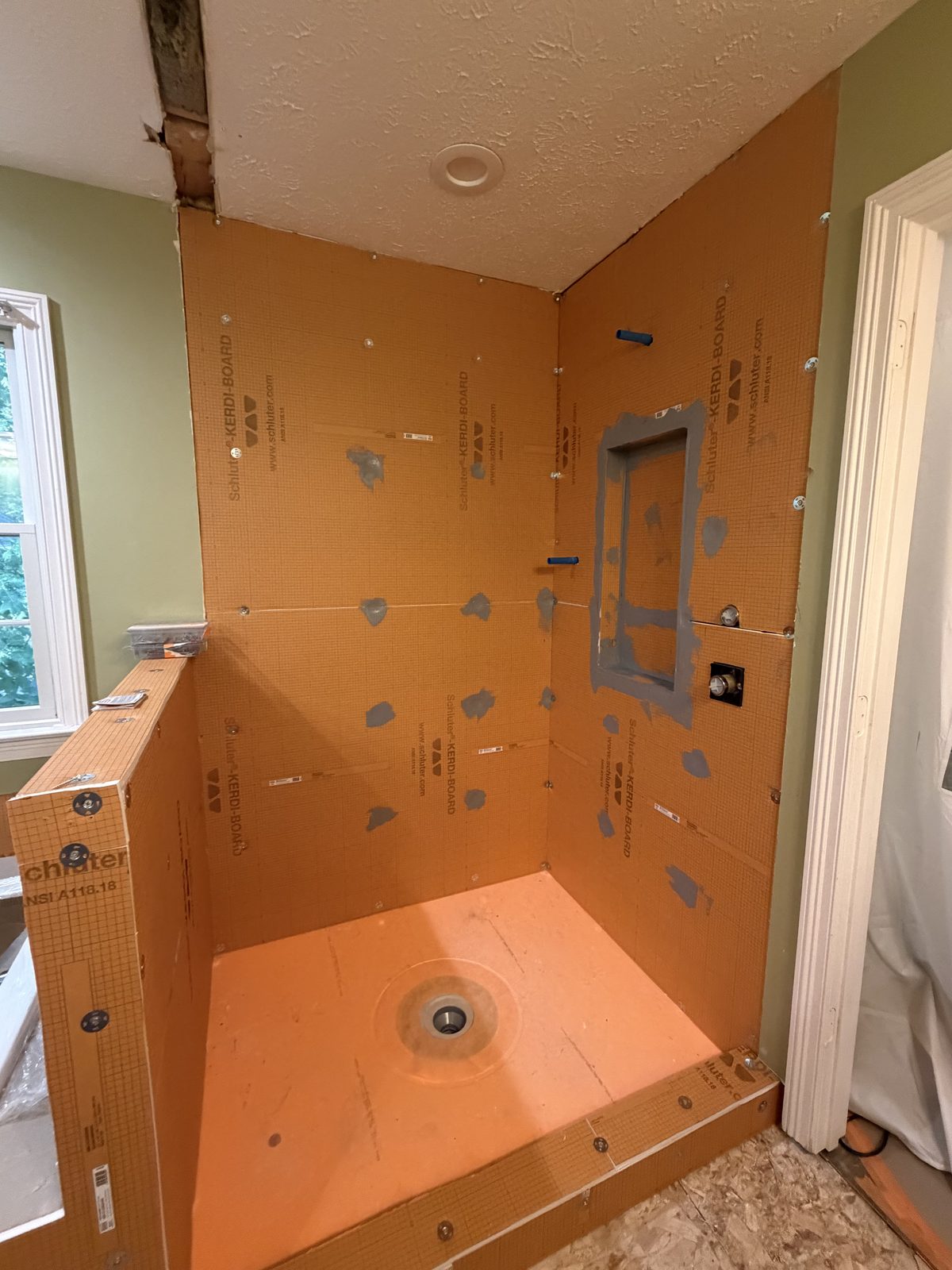
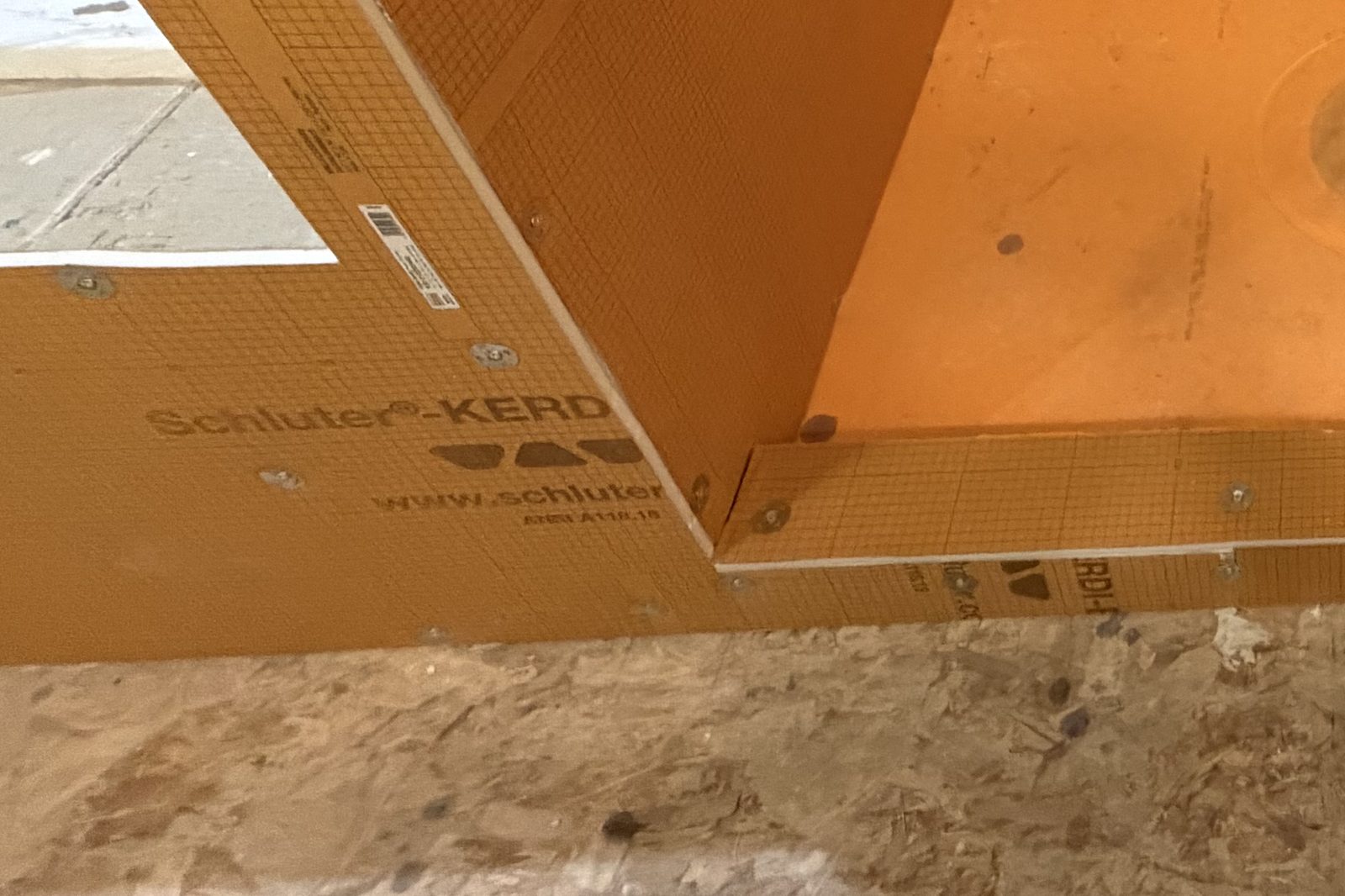
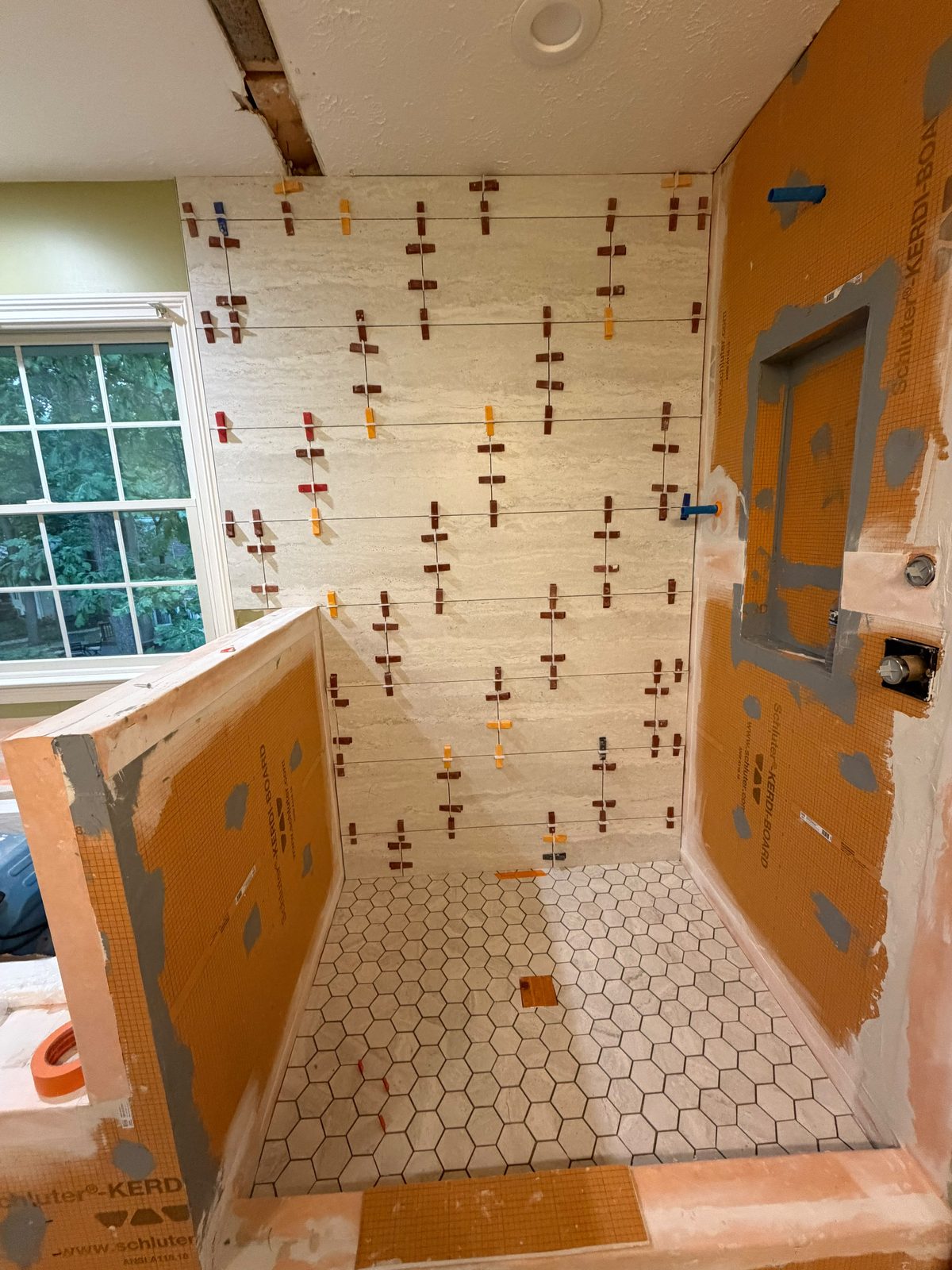
The photographs below are from a primary bath we finished in Noblesville this autumn, and they are worth looking at because this is the only stage of a bathroom where the waterproofing can be seen at all. Those are Kerdi-Board panels — the branding and the ANSI A118.10 marking are still legible on them — screwed to the studs with washered fasteners, with every seam, corner and screw head banded and sealed. There is no membrane over them because none is needed. The board is the waterproofing.
Note the drain in the pan. It is a bonding flange drain, which ties the pan into the same waterproof plane as the walls rather than passing through the assembly beside it. That detail is worth understanding whichever product you use: a drain bonded to the waterproofing gives water one continuous surface from the wall to the drain body, and a drain that merely passes through gives it a seam to find.
Niches and benches are where Kerdi-Board earns its keep regardless of what the walls are. A niche is a hole deliberately cut into a wet wall, and a bench is a horizontal surface inside a shower — the two places a shower is most likely to leak. Foam board can be cut, stacked and shaped into both without introducing anything that can rot, and preformed Kerdi-Board niches and benches exist for exactly that reason.
Then there is Ditra, which is the third product in the confusion and the one with a firm answer: it does not go on a shower wall. Ditra is an uncoupling membrane for floors. Its job is to let a tile assembly and the slab or subfloor beneath it move independently so the tile does not crack when the structure shifts, and it waterproofs as a secondary benefit. On a bathroom floor outside the shower it is exactly right. Inside the shower, on a wall, it is the wrong tool with the right brand on it.
Both of the Noblesville primary baths we finished this autumn used Kerdi-Board through the wet area and Ditra under the floor tile beyond it — verified from the build photographs of each, not from the specification, because the two do not always agree. That pairing is the normal arrangement, not a special one.
Cement board brands come up in the same searches — Durock, HardieBacker, PermaBase. For this decision they are interchangeable with one another and all sit on the same side of the line: they are water-resistant substrates that need a waterproofing layer over them. Cement board does not absorb water the way drywall does, which is why it is often described as waterproof, but water passes through it to the framing behind. That distinction is the whole argument, and we covered it at length in our Kerdi board versus cement board comparison.
The warranty is the practical reason to care about getting the combination right. Schluter's 25-year coverage applies to the assembly, not to one product in isolation, which means the membrane or board, the band at the seams, the corners and the drain all have to be Schluter components installed to Schluter's instructions. Mixing a Kerdi wall with a non-Schluter drain is the most common way a homeowner ends up with a shower that is perfectly well built and not actually covered.
If you are specifying a shower in Fishers, Carmel, Noblesville, Westfield or Zionsville and are not sure which assembly you are being quoted, the question worth asking your contractor is simply this: what is the waterproofing layer, and is the drain part of it? A contractor who builds these every week will answer in one sentence. Every HomeStar estimate is walked in person, and the waterproofing assembly is specified in writing before anything is ordered.
Frequently Asked Questions
Is Kerdi-Board the same as Kerdi membrane?
No. Kerdi-Board is a rigid foam panel that serves as the wall substrate and is waterproof in itself, so it replaces cement board. Kerdi membrane is a thin sheet bonded with thinset over a substrate that already exists. The board is substrate and waterproofing together; the membrane is waterproofing added to a separate substrate.
Do I need Kerdi membrane over Kerdi-Board?
No, and doing it adds cost without adding protection. Kerdi-Board is already waterproof through its thickness. What it does need is Kerdi-Band at the seams, in the corners and at any fastener penetration, because the panel joints are the only places water can reach the framing.
Can I use Ditra on shower walls?
No. Ditra is an uncoupling membrane designed for floors, where its job is to let the tile and the subfloor move independently so the tile does not crack. It is the right product for the bathroom floor outside the shower and the wrong one for a shower wall. Use Kerdi or Kerdi-Board in the wet area.
Kerdi-Board vs Durock: which should I use?
Durock is a cement board, so this is the same comparison as Kerdi-Board versus cement board generally. Durock is a water-resistant substrate that still needs a waterproofing layer over it; Kerdi-Board is waterproof on its own. Durock plus a bonded Kerdi membrane and Kerdi-Board are both complete, warrantable assemblies. Durock with nothing over it is not.
Is Kerdi-Board worth the extra cost over cement board?
On a gut, usually yes, because you are comparing one product against two. Cement board needs a waterproofing layer bonded over it, so the honest comparison is Kerdi-Board against cement board plus membrane plus the labour to install it. Over a sound existing cement board wall the maths changes and bonding Kerdi over what is already there is normally the better value.
Does the drain have to be Schluter too?
For the 25-year manufacturer warranty, yes. The coverage applies to the assembly rather than to any single product, so the membrane or board, the seam band, the corners and the drain all need to be Schluter components installed to Schluter's instructions. A bonding flange drain also ties the pan into the same waterproof plane as the walls, which is better construction regardless of the paperwork.
Ready to start your project?
Get a Free Estimate